Your Hands Are the Bottleneck (Your Brain Isn't)
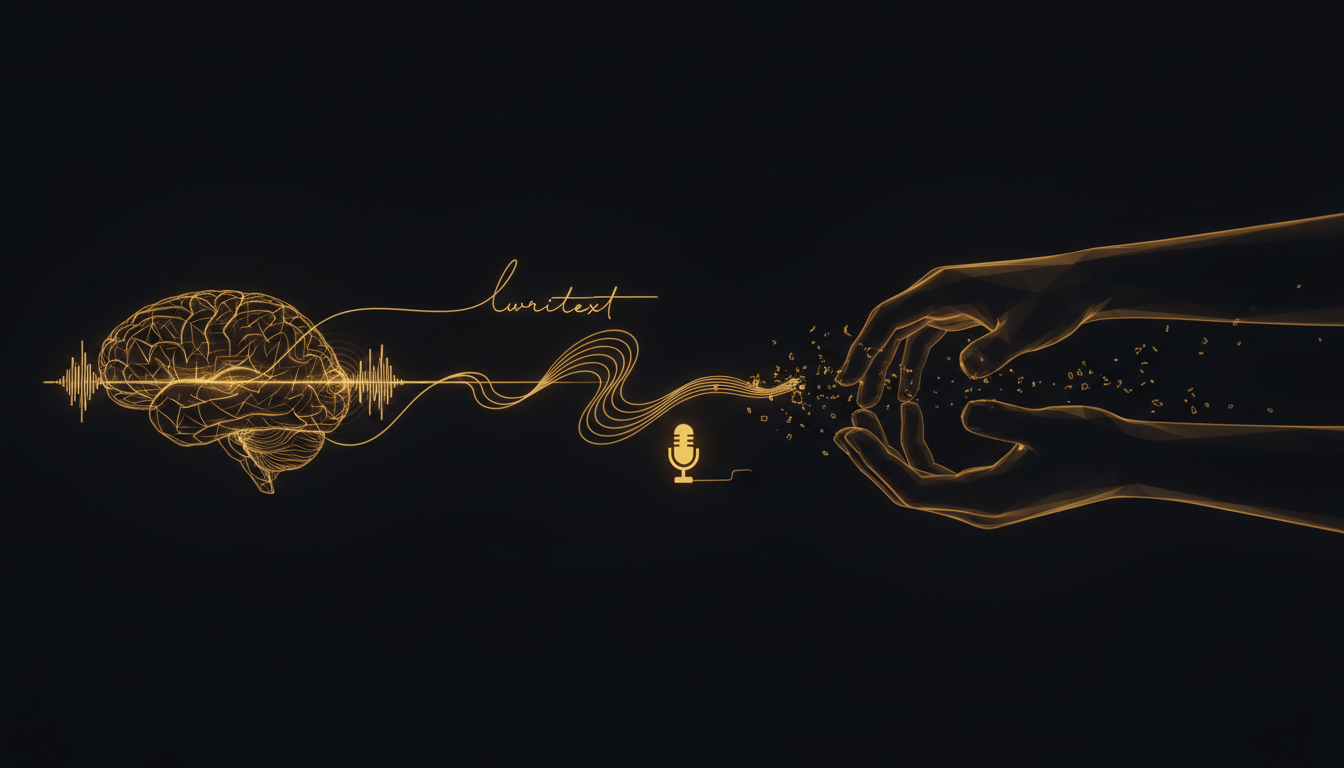
You have a thought. A good one. Clear, complete, ready to go. Then you start typing, and somewhere between your brain and the keyboard, it gets smaller. The words slow down. The idea loses its shape. This is not a writing problem. It is a physical bottleneck.
The Numbers Don't Lie
The average person types between 40 and 80 words per minute. Fast typists push past 100. But conversational speech runs at 130 to 150 words per minute, and internal thought moves faster still, closer to 400 words per minute by some estimates.
That gap is not just a speed problem. It is a cognitive load problem. When your hands cannot keep up, your brain does not wait patiently. It starts compressing, simplifying, dropping things. You edit before you write. You lose the thread.
What Gets Lost in Translation
Watch someone trying to explain a complex idea in a meeting. They are fluid, fast, and specific. Ask them to write the same thing down, and it takes three times longer and comes out flatter. The keyboard imposes structure before the thought is ready for structure.
Writers know this feeling as the blank page. Developers know it as the struggle to write documentation after the code already makes sense in their head. It is not a creativity problem. It is a throughput problem.
Typing Is a Skill That Hides the Cost
Because most of us have typed for decades, we mistake familiarity for efficiency. Typing feels natural. But so did writing by hand before keyboards, and nobody argues that longhand is faster.
The cost of the keyboard is invisible because it is constant. You never see the thoughts you lost. You never measure the ideas that got compressed into something simpler because your fingers could not keep up.
Voice Changes the Math
Dictation does not just add speed. It changes the relationship between thinking and capturing. When you speak, you can stay in the thought instead of managing the mechanism for recording it.
Tools like VoiceInk are built around this idea. You press a key, speak, and your words appear wherever your cursor is. There is no mode-switching, no separate app, no cloud upload. The friction is low enough that speaking starts to feel like a natural extension of thinking rather than a performance.
The Adjustment Is Real
Speaking your writing is not immediately comfortable. The first few sessions feel awkward. You say "um" and pause in odd places and feel self-conscious even though no one is listening.
This passes faster than most people expect. After a week of regular dictation, most people settle into a rhythm. The key is to dictate without editing, treating it like a brain dump rather than a first draft. Fix it later. Capture it now.
What to Try First
Start with low-stakes output. Dictate a reply to an email you have been putting off. Talk through your task list for the day. Describe a problem you are trying to solve.
You are not trying to write a book on day one. You are training yourself to stop translating thought into keystrokes and start letting it flow directly into words.
Once that clicks, the bottleneck opens up. Your brain and your output finally run at closer to the same speed.
If you have never tried dictation seriously, it is worth one week of honest effort. Not because it is a perfect replacement for typing, but because you deserve to know what you have been leaving on the table.
Stop typing. Start talking.
VoiceInk turns your voice into text in any app. Local, fast, private. Free to start.
Download VoiceInk Free