You Talk at 130 WPM. Why Are You Still Typing at 40?
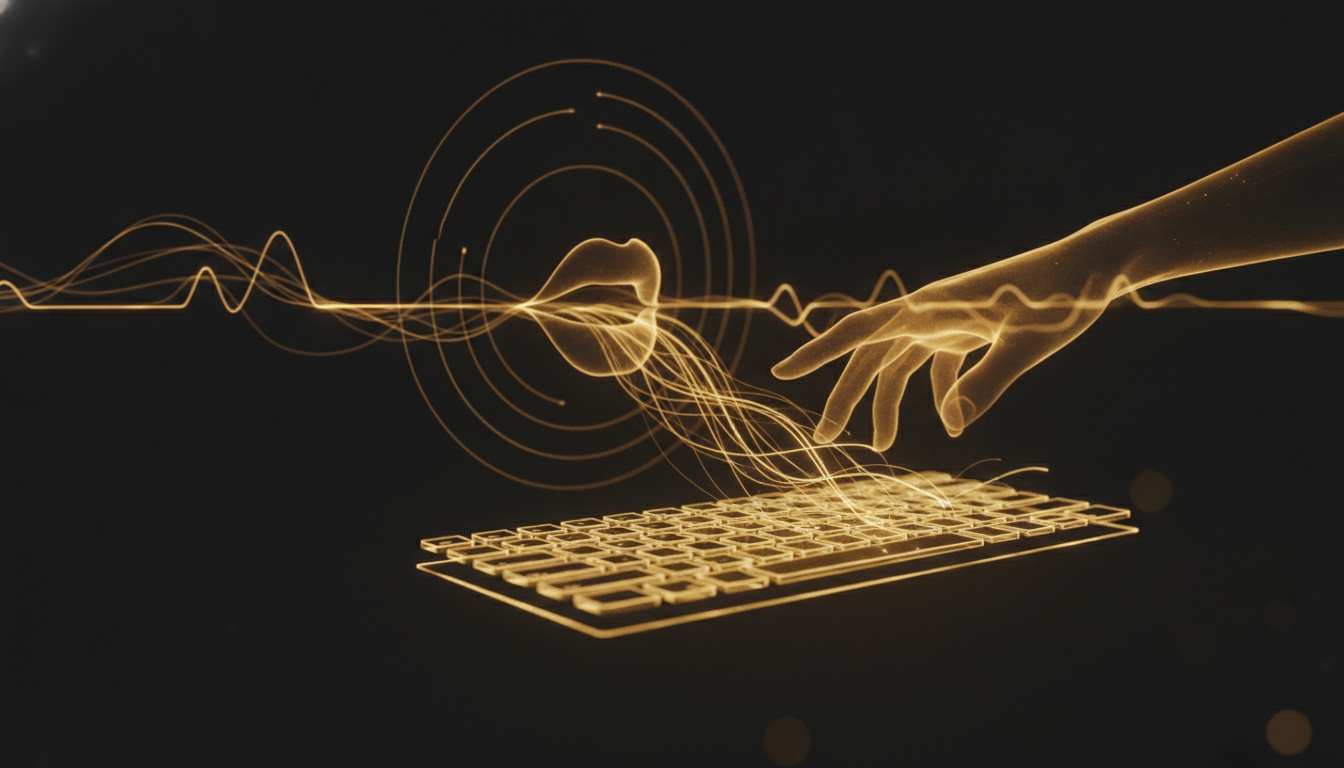
Most people type somewhere between 35 and 50 words per minute. Most people speak at around 130. That gap is not a minor inefficiency. It is a wall you hit every single time you sit down to write something.
The Math Nobody Talks About
Let's make it concrete. Say you need to write a 600-word email explaining a project delay to a client. At 40 words per minute, that is 15 minutes of typing, not counting the time you spend staring at the screen, backspacing, or rewording sentences because the act of typing slowed your thinking down.
Speak that same email out loud and you are done in under five minutes.
Now multiply that across a full workday. If you spend two hours writing, emails, documents, notes, messages, the speed gap alone costs you roughly 90 minutes of output. You are not getting that time back by typing faster. Even a skilled typist at 70 words per minute is still running at half the speed of natural speech.
The bottleneck is not your brain. It is your hands.
Why Typing Feels Normal Even When It Slows You Down
Typing has been the default for so long that most people have stopped noticing how much friction it adds. You sit down to write, your fingers find the keyboard, and you begin the slow process of converting thought into keystroke.
But thought does not arrive in keystrokes. It arrives in bursts, in half-formed sentences, in momentum. The moment you have to slow that momentum down to match your typing speed, you lose some of it. You have probably felt this: a good idea that felt clear in your head comes out flat on the page, partly because the lag between thinking and typing gave you time to second-guess it.
Speaking skips that lag. When you talk, you are closer to the raw material of the idea. The words come out at the speed you are thinking them, which means less time for self-editing to get in the way, especially in a first draft.
The Typing Speed Ceiling Is Real
There is a ceiling to how fast you can type, and for most people it is well below 60 words per minute. Getting from 40 to 60 takes months of deliberate practice. Getting from 60 to 80 takes years. Even if you put in that work, you are still not close to the speed of speech.
Voice dictation, on the other hand, does not require practice to be faster than typing. On day one, speaking into a microphone and watching your words appear in any app you are working in is already three times faster than your average typing speed. The learning curve is about adjusting your habits, not building a new skill from scratch.
Tools like VoiceInk make the barrier very low. You press a key, you speak, your words appear wherever your cursor is sitting, whether that is a Google Doc, an email client, a notes app, or a code editor. There is no special interface to work inside. It just drops text where you need it.
What the Speed Gap Feels Like in Practice
Imagine you are a developer who needs to write inline comments and documentation. The code itself you write by hand, but the explanations around it, the why-this-exists, the edge-case warnings, the README sections, those are prose. And prose is exactly where the typing bottleneck bites hardest.
Or imagine you are a writer working on a first draft. You know what happens in the next scene. You can see it. But by the time you have typed three sentences, the picture has already started to fade because typing is slow enough to let doubt catch up to momentum.
Or you are someone who handles a heavy email load. Every reply is a small piece of writing that takes longer than it should, multiplied across 40 or 50 messages a day.
In every one of these cases, the problem is the same. Output speed is capped by typing speed, not by thinking speed.
Speaking Is Not Just Faster, It Is Different
There is something worth saying about the quality of dictated writing, not just the quantity. When you speak, you tend to use more natural sentence rhythm. You avoid certain kinds of stiffness that come from composing word by word on a keyboard. Writers who dictate first drafts often find them easier to edit because the voice on the page sounds more like a human being and less like a document.
That is not universal. Some people find dictation awkward at first, especially for technical or structured writing. But the awkwardness tends to fade once you stop treating dictation as a parlor trick and start treating it as a first-draft tool. The draft does not have to be clean. It has to exist. You can fix it later, and if you are using something like VoiceInk's Refine feature, you can have it cleaned up automatically before it even hits the page.
The RSI Angle Nobody Wants to Think About Until It Is Too Late
Speed is one reason to care about this. Pain is another.
Repetitive strain injuries, carpal tunnel, tendonitis, general wrist and hand fatigue, are common among people who type for a living. They build slowly. For months you ignore a little tightness in your forearm. Then one day the tightness is there all the time. Then it starts affecting your sleep.
Reducing keyboard time is one of the most direct ways to reduce that risk. Dictation does not eliminate typing, but shifting even half your writing to voice cuts your daily keystroke count significantly. For people who already have symptoms, it can be the difference between managing and worsening.
A Practical Way to Start
You do not have to overhaul the way you work overnight. Start with one type of writing, the kind you do most often that feels like a slog. For most people that is email. Try dictating your next five email replies instead of typing them. Notice how long it takes. Notice whether the words come easier or harder.
If you are on Mac or Windows, VoiceInk has a free plan that lets you try this without committing to anything. Press a key, speak, see what happens. The free tier is enough to get a real sense of whether dictation fits how you work.
The speed gap between talking and typing has always been there. The tools to close it are better now than they have ever been. At some point it stops being a niche workflow tip and starts being an obvious question: if you can say it three times faster than you can type it, why are you still typing it?
Try talking for a week and see what changes.
Stop typing. Start talking.
VoiceInk turns your voice into text in any app. Local, fast, private. Free to start.
Download VoiceInk Free