Why Your Hands Are the Bottleneck (Not Your Brain)
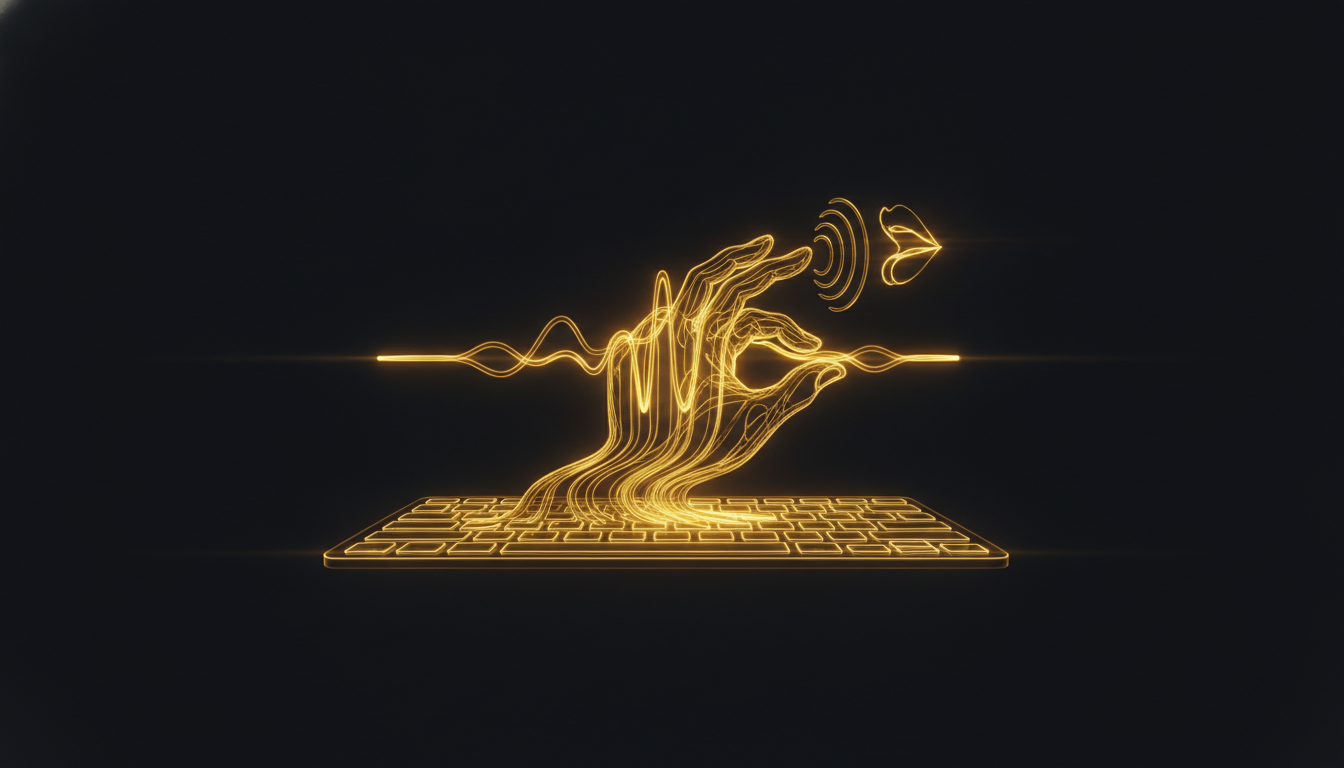
You have the idea. It's clear, sharp, fully formed. Then you start typing, and somewhere between your brain and the keyboard, most of it disappears. This isn't a focus problem. It's a physics problem.
The Numbers Don't Lie
The average person speaks at 130 words per minute. Fast typists hit around 80. Most people who think of themselves as decent typists are somewhere between 55 and 70 words per minute on a good day, on a familiar keyboard, without errors.
Meanwhile, your internal monologue runs at 400 words per minute or faster. That's the cognitive speed research consistently points to when measuring verbal thought. The gap between what you can think and what you can type isn't small. It's enormous.
Every time you sit down to write, you're running a firehose through a garden hose.
What Gets Lost in Translation
When your output speed can't keep up with your thinking speed, you don't just write slower. You think differently. You start editing before you've finished a sentence. You lose the thread of a longer argument because you forgot the second half while you were typing the first. You write shorter, simpler sentences not because they're better, but because they're survivable.
Writers call this the internal critic. But a lot of what gets labeled as writer's block is actually a mechanical problem. The keyboard creates friction, and friction kills momentum.
Speaking Changes the Equation
When you dictate, you stop fighting the bottleneck. Your output speed jumps to match something closer to your thinking speed. The words come out in longer, more natural runs. You don't stop mid-thought to hunt for a key.
This isn't just faster. It's qualitatively different. Dictated first drafts tend to be more conversational, less over-edited, and structurally closer to how you actually think. That's often a feature, not a bug. Editing a verbose draft is easier than trying to expand a sparse one.
The Muscle Memory Trap
Most people resist voice input because typing feels natural. It does. You've done it for years. But familiarity isn't the same as efficiency. You're used to the friction. That doesn't mean the friction isn't costing you.
Consider what you do when you're not at a keyboard. You talk through problems with colleagues. You leave yourself voice memos. You explain things out loud when you're stuck. Your brain already defaults to speech when the stakes are low enough that you're not performing. Dictation just brings that mode to your actual work.
Closing the Gap
Tools like VoiceInk are built around this exact problem. You press a key, say what you mean, and the words appear wherever your cursor is sitting, inside any app, with no cloud processing and no lag. The goal isn't to replace typing entirely. It's to stop using your hands for the parts where your hands are the weakest link.
Long-form thinking, email drafts, documentation, rough ideas you want to capture before they fade, these are all better served by your voice than your fingers.
The keyboard will still be there for the editing pass. Let your brain off the leash first.
If you've never tried dictating into your actual workflow, not just a voice memo app, give it a week. The gap between what you can think and what you can output is real. Closing it even partially changes how much you get done and how much of your thinking actually survives the journey from your head to the page.
Stop typing. Start talking.
VoiceInk turns your voice into text in any app. Local, fast, private. Free to start.
Download VoiceInk Free