Why Your Hands Are the Bottleneck (And What to Do About It)
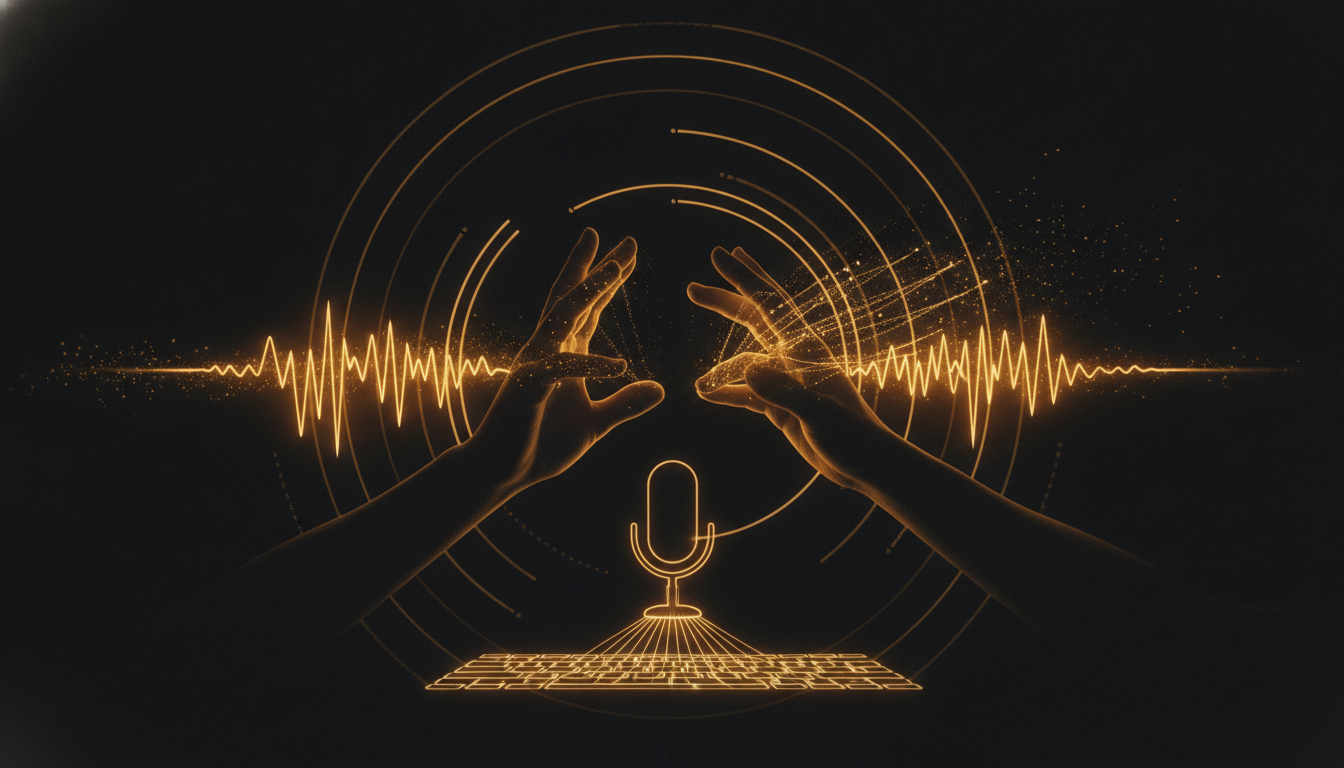
Most people assume they think at the speed they type. They don't. The average professional types around 40 words per minute. The average person speaks at 130. That three-to-one gap isn't just a productivity statistic. It's where half-formed ideas get dropped, sentences get abbreviated, and the energy of a thought dies before it reaches the page.
The Compression Problem
When you type, your brain doesn't pause and wait. It keeps generating. So you start compressing, cutting words before you write them, simplifying sentences mid-thought, abandoning tangents that might have been valuable. You're not writing what you think. You're writing a reduced version of it.
This is the real cost of the typing bottleneck. Not time, though time matters. The real cost is fidelity. The thought you typed is not the thought you had.
Where Speed Actually Comes From
People who want to write faster usually practice typing. They do drills, buy mechanical keyboards, optimize their layouts. Some of that helps. A fast typist might hit 80 or 90 words per minute. That's real progress, but it still leaves a 40-to-50 word gap between speaking and typing speed, and it takes months of practice to close even half of it.
Speaking is different. You already do it at 130 words per minute. You've been doing it your whole life. There's no practice curve. The speed is already there.
The Hands Are Not the Point
Here's what most people miss: typing isn't valuable because it uses your hands. It's valuable because it gets words into a document. The hands are just the delivery mechanism. If there's a faster mechanism that produces the same output, the hands become optional.
Voice dictation is that mechanism. Tools like VoiceInk let you press a key, speak, and have your words appear in whatever app is in focus. No cloud upload, no waiting, no switching windows. The transcription happens locally, in under a second. The words land where your cursor is, the same as if you'd typed them.
When Typing Still Wins
This isn't an argument to never type. Typing has real advantages. It's quiet. It works in meetings and libraries and open offices. It's precise for short inputs like terminal commands or form fields. If you're writing one sentence, the overhead of switching to voice isn't worth it.
But for sustained output, for drafts, emails, documentation, notes, voice is faster every time. The people who resist this usually haven't tried it for more than ten minutes. The first session feels awkward. By the third, it starts to feel obvious.
The Thinking-to-Text Pipeline
The goal of any writing tool is to shrink the distance between a thought and a finished sentence. Keyboards shrank that distance compared to longhand. Voice shrinks it further.
When you dictate, you stop managing your hands and start managing your ideas. You notice things you weren't noticing before: that you repeat yourself, that your sentences run long, that you hedge constantly. These are useful things to notice. They make you a better writer, not just a faster one.
The bottleneck was never your ideas. It was the pipeline between your ideas and the page. Your hands were that pipeline, and they were slow.
If you've never tried dictating for a full 20 minutes, it's worth doing once just to feel the difference. You might not go back.
Stop typing. Start talking.
VoiceInk turns your voice into text in any app. Local, fast, private. Free to start.
Download VoiceInk Free