Why Your Hands Are the Bottleneck (Not Your Brain)
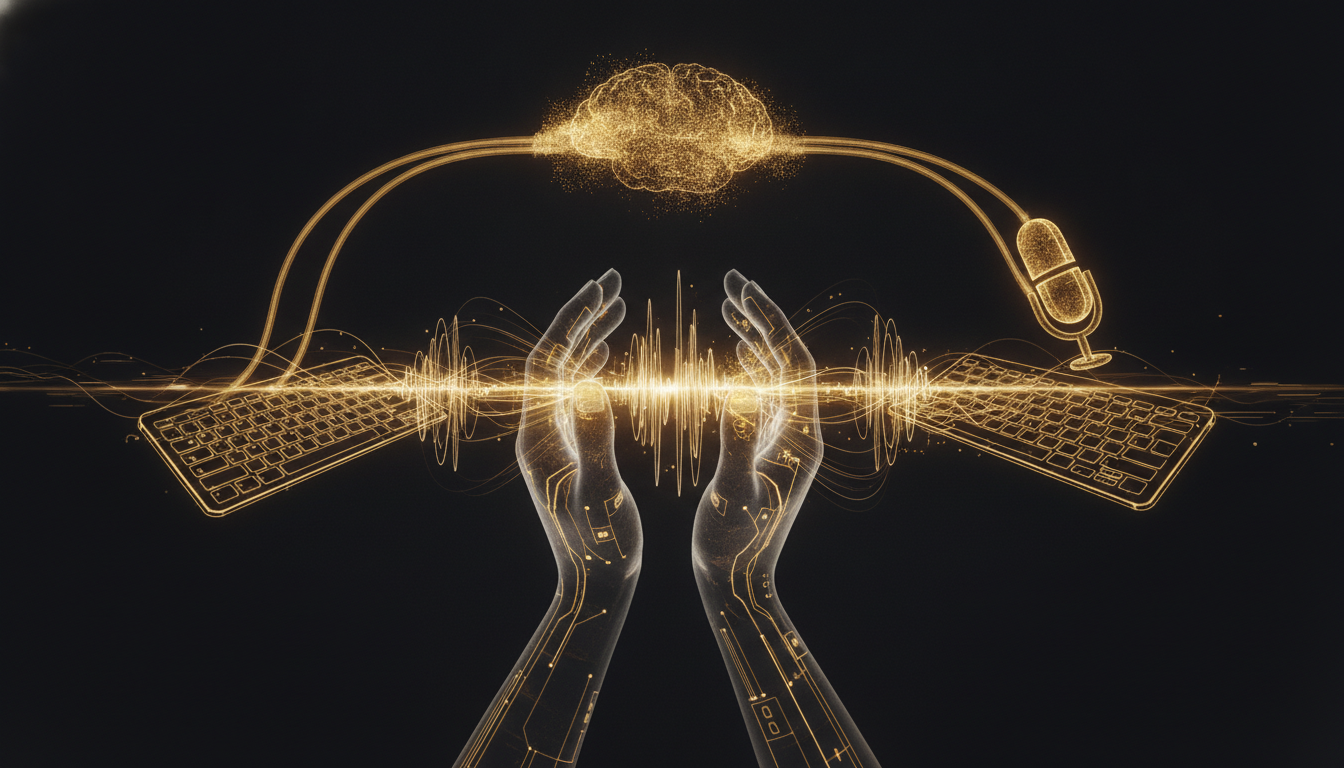
Most people speak at around 130 words per minute. The average typing speed sits closer to 40. That threefold gap is not a minor inefficiency. It is where your best sentences go to die.
The Brain Moves Faster Than Your Fingers
Think about the last time you had a really clear idea, a sharp argument, a perfect opening line. You reached for the keyboard, started typing, and somewhere around word twelve, the thread slipped. You had to reconstruct it. The version you typed was close, but not quite the thing you originally had.
This happens because working memory is short. It holds roughly four chunks of information at a time, and it does not wait for your fingers. By the time you finish typing a sentence, your brain has already moved on and started overwriting what came next.
Speaking does not eliminate this problem, but it closes the gap significantly. You can externalize a thought before your brain discards it.
Typing Speed Is a Hard Ceiling
Practicing typing helps, but there is a ceiling. Professional typists top out around 100 to 120 words per minute, and getting there takes years of deliberate effort. Even at that speed, you are still slower than natural speech.
More importantly, typing speed is not the real constraint for most knowledge workers. The constraint is the mental overhead of managing fingers, keyboard layout, typos, and corrections all at once. That overhead competes with the cognitive work of actually thinking.
Writers know this as the difference between drafting and editing. When you type, you are often doing both simultaneously. You write a word, it looks wrong, you delete it. The inner editor and the inner writer fight for the same channel.
Voice Separates Drafting from Editing
Dictating forces a different mode. You cannot easily go back mid-sentence and second-guess a word choice. You keep moving. That constraint turns out to be a feature. Momentum builds. Sentences connect. You produce a rough draft instead of a half-edited fragment.
This is why many writers, attorneys, and executives have dictated their work for decades. The technology was always there in some form. What changed recently is accuracy and latency. Tools like VoiceInk run the transcription locally on your Mac, so there is no round trip to a server. You speak and the words appear almost instantly, in whatever app you are already using.
The Correction Tax
One objection people raise is accuracy. What about mistakes? This is worth taking seriously. Even at 98 percent word accuracy, a 500-word dictation has about ten errors. That sounds like a lot until you compare it to the time you spend backspacing and retyping during a normal typing session.
The difference is when the corrections happen. With dictation, you draft fast and clean up once at the end. With typing, corrections interrupt the flow constantly. The total time spent may be similar, but the quality of the draft tends to be higher with dictation because the thinking was not fragmented.
What You Actually Lose by Typing Everything
Beyond speed, there is a subtler cost. Typing is tiring. It demands fine motor precision for hours at a stretch. That fatigue accumulates across a workday and across a career. Many people do not notice how much mental energy goes into the physical act of typing until they take a break from it.
Speaking is something humans have done for hundreds of thousands of years. It is lower effort, more natural, and better suited to capturing continuous thought.
Your hands are remarkable tools. They are just not the best tool for getting ideas out of your head.
If you have never tried dictating your work, even for a single afternoon, it is worth the experiment. The gap between what you think and what you type might be larger than you realized.
Stop typing. Start talking.
VoiceInk turns your voice into text in any app. Local, fast, private. Free to start.
Download VoiceInk Free