Why Your Hands Are the Bottleneck (Not Your Brain)
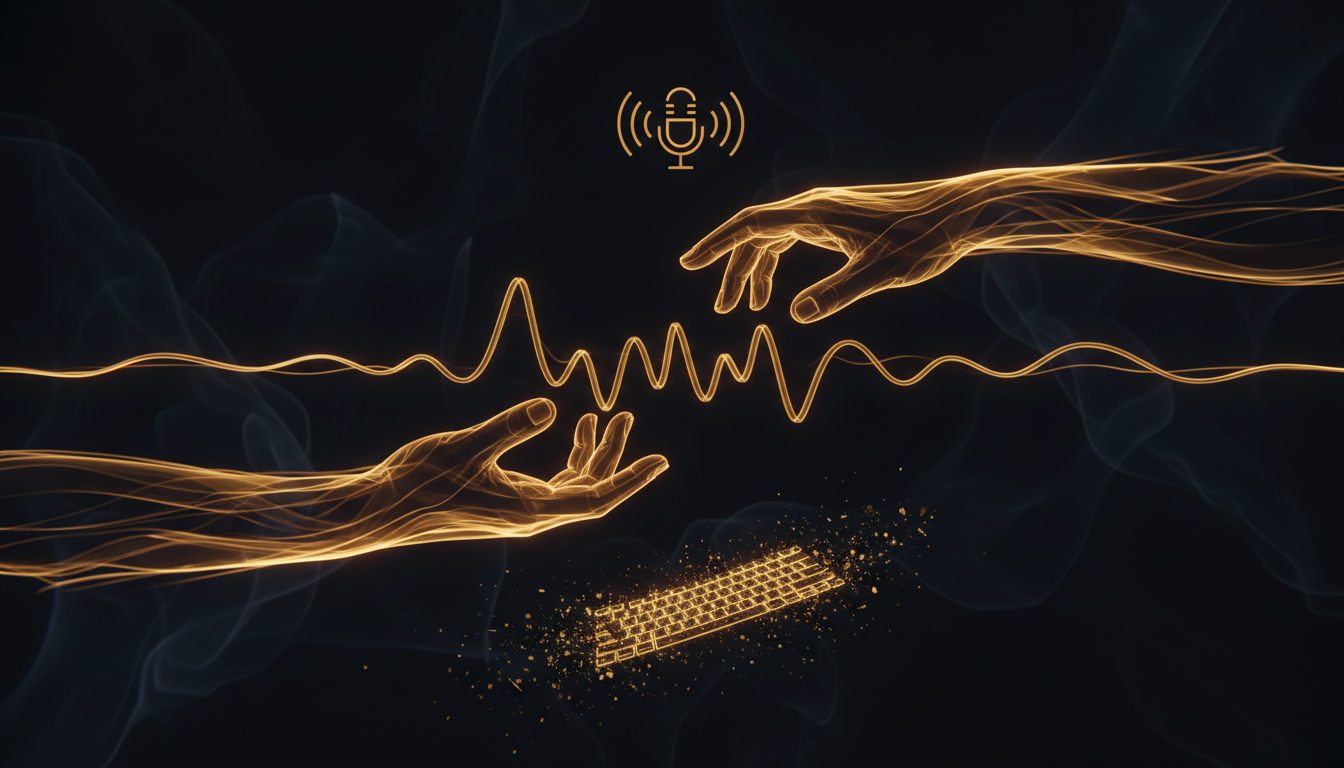
You have a thought. It arrives fully formed, with texture and momentum. By the time your fingers finish encoding it, something is lost. Not because you are a bad writer, but because your hands are too slow.
The Numbers Are Blunt
The average person types around 40 words per minute. Fast typists hit 80. Trained stenographers reach 200. But speaking? Most people land between 120 and 150 words per minute without trying. That is a 3x gap between what your brain produces and what your keyboard captures.
Every sentence you type is a compression exercise. You are not writing what you think. You are writing a reduced version of it, shaped by what your fingers can keep up with.
The Cognitive Cost of Slow Output
When output is slow, the brain does not wait patiently. It starts editing before you finish. It second-guesses word choices mid-sentence. It interrupts the flow of ideas with mechanical concerns, spacing, punctuation, did I spell that right.
This is not a discipline problem. It is a hardware mismatch. Your thinking runs at one speed and your input method runs at another. The friction between them is where writer's block lives.
Speaking does not eliminate this friction entirely, but it reduces it dramatically. When you talk, you follow the thought rather than transcribe it. The output rate is close enough to the thought rate that ideas survive the transfer.
What Happens When You Switch
People who start dictating consistently report the same thing: their first drafts are longer, messier, and better. Longer because they are not rationing words through slow fingers. Messier because they are not self-editing in real time. Better because the original shape of the idea makes it onto the page.
The mess is easy to clean up in editing. The lost idea is gone.
Tools like VoiceInk make this practical on a Mac. You press a key, speak, and your words appear in whatever app is open. No mode switching, no separate window, no copy-paste. The gap between thinking and writing shrinks to almost nothing.
The Typing Reflex Is Learned, Not Natural
Most people treat typing as the default and voice as the novelty. But typing is a technology from the 1870s. The keyboard was designed for mechanical arms that needed space to reset, not for human thought. We have just used it so long it feels native.
Voice is how humans communicated for 200,000 years before writing existed. Speaking to capture ideas is not a workaround. It is a return to the most natural output method we have.
The Real Bottleneck
Your ideas are not the problem. Your ability to think, synthesize, and generate content is almost certainly faster than your output rate suggests. The constraint is mechanical. Forty words per minute of finger movement is the ceiling, and most people hit it every day without realizing it is there.
Removing that ceiling does not guarantee better writing. But it does guarantee that more of what you actually think makes it into the document. What you do with it after that is up to you.
If you have never tried dictating a first draft, it is worth one serious attempt. Not a sentence or two, but a full paragraph or a full page, spoken at conversational speed. See what comes out. You might be surprised how much was waiting.
Stop typing. Start talking.
VoiceInk turns your voice into text in any app. Local, fast, private. Free to start.
Download VoiceInk Free