Why Your Hands Are the Bottleneck (Not Your Brain)
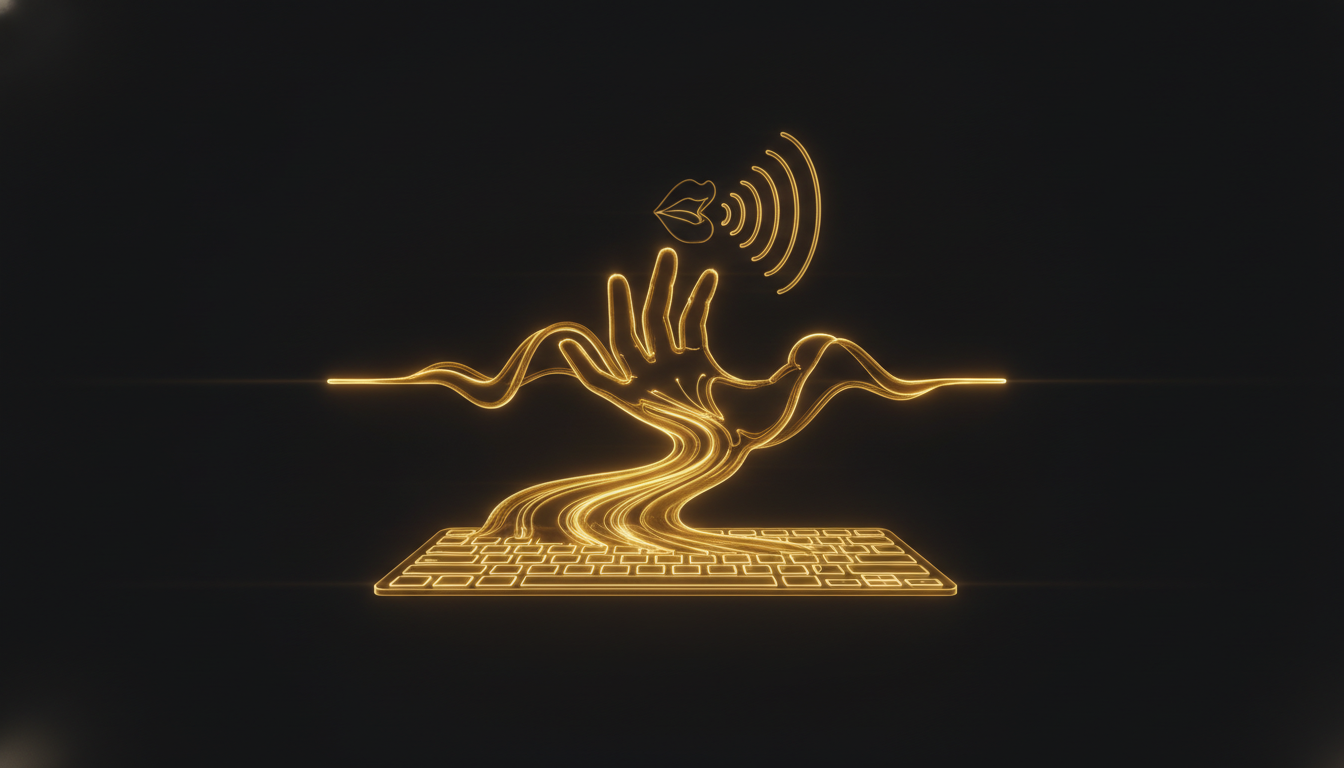
Most people assume they think at the speed they type. They don't. The average professional types around 40 words per minute. The average person speaks at 130. That's not a small gap, it's a three-to-one ratio between what your brain produces and what your hands can deliver.
The Math Nobody Does
Take a 600-word email. At 40 wpm, that's 15 minutes of typing. At speaking pace, it's under 5 minutes. Do that three times a day, five days a week, and you've spent roughly 150 extra hours a year just waiting for your fingers to catch up.
That number gets worse if you're a writer, a developer writing documentation, or anyone whose job is producing text. The bottleneck compounds every single day.
What Gets Lost in the Gap
Speed isn't the only problem. When you type slowly relative to your thinking, ideas evaporate before they land. You'll start a sentence with a clear thought and by the time you've typed the first clause, the second half is gone. Writers know this feeling. So do developers trying to capture a fast-moving idea mid-debug.
Speaking lets you stay inside the thought. You don't have to hold an idea in short-term memory while your hands try to keep up. The words come out at the same pace the idea forms.
Typing Speed Has a Hard Ceiling
You can practice typing and improve. But there's a ceiling, and most people hit it years ago. Getting from 40 wpm to 60 wpm takes months of deliberate practice. Getting from 60 to 80 takes even longer. Meanwhile, speaking at 130 wpm is something almost everyone already does, naturally, without training.
Voice dictation doesn't require practice to be faster than typing. It requires only the willingness to try it.
The Accuracy Problem (And Why It's Mostly Solved)
For years, voice recognition was the bottleneck instead of your hands. Early dictation tools were slow, required training, and made enough errors that you spent the time you saved fixing mistakes.
That's changed. Tools like VoiceInk use modern transcription models that run locally on your Mac and hit accuracy rates above 95% in normal conditions. A missed word here and there is faster to fix than typing the whole thing. The math still works in voice's favor.
When Typing Still Wins
This isn't an argument that typing is useless. Code is better typed. Short replies, passwords, and anything requiring precise punctuation are faster with a keyboard. Typing in a quiet office meeting where speaking would be disruptive is obviously the right call.
But for prose, for long-form writing, for notes, emails, documentation, and first drafts, typing is the wrong tool. You're using a bicycle when you could be using a car, and calling it a workout.
Breaking the Habit
The reason most people don't switch isn't that dictation is hard. It's that typing feels natural. You've done it for decades. The keyboard is right there. Picking up a new habit, even a faster one, has friction at the start.
The shift gets easier once you see the output. Write a single long email by speaking it. Notice how long it took. Notice that the words came out clearer than usual because you weren't parsing and re-parsing while your fingers caught up. That's the version of writing your brain was always capable of.
Your hands were just in the way.
If you've never tried dictating directly into your Mac, it takes about two minutes to set up and one conversation's worth of words to feel the difference. Give it one real try before writing it off.
Stop typing. Start talking.
VoiceInk turns your voice into text in any app. Local, fast, private. Free to start.
Download VoiceInk Free