Why Your Hands Are the Bottleneck (And How to Fix It)
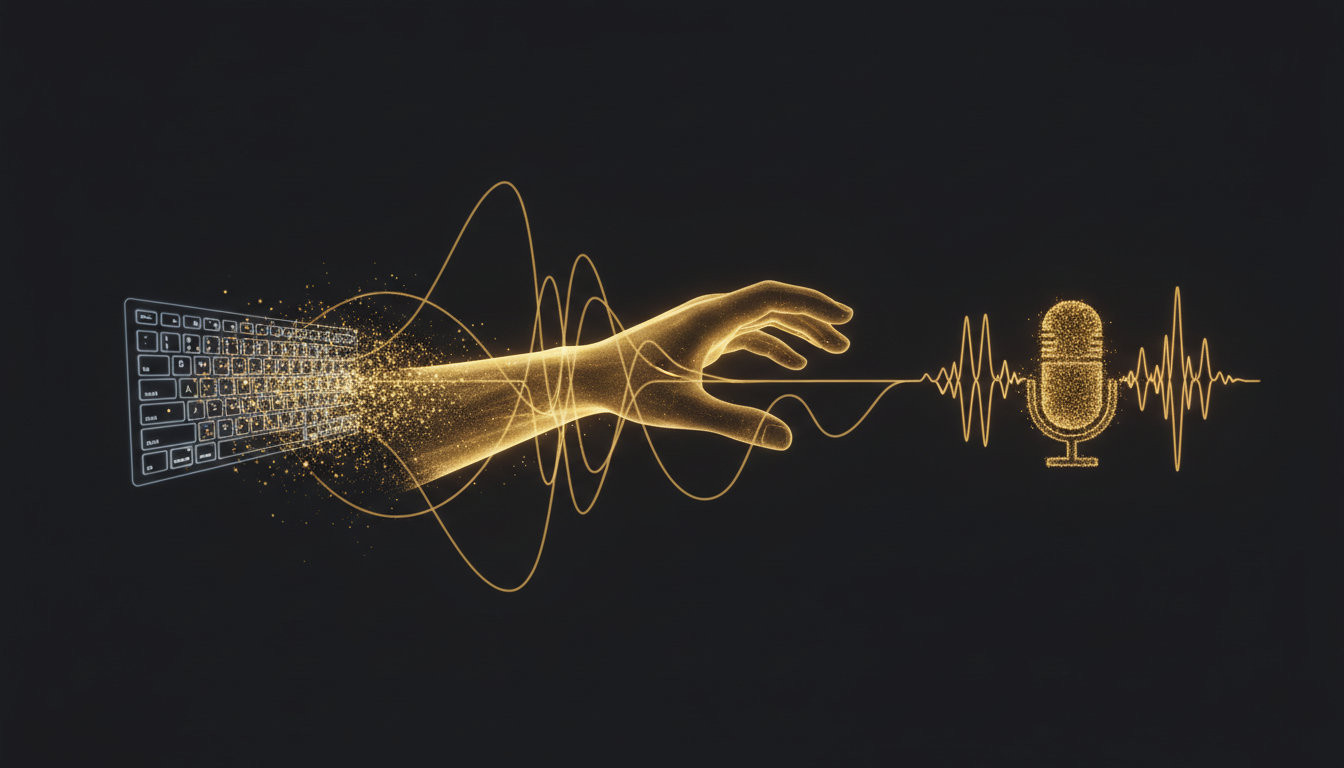
Most people speak at around 130 words per minute. The average typing speed sits closer to 40. That is not a small gap. It is the difference between keeping up with your thoughts and constantly falling behind them.
The Speed Problem Is Real
When you type, your brain does not slow down to match your fingers. It keeps running ahead, generating ideas, refining arguments, making connections. Your hands are chasing something they can never quite catch.
The result is a kind of cognitive drag. You lose the thread. You simplify sentences not because they should be simpler, but because simpler is faster to type. You cut the good stuff to keep moving.
This is not a discipline problem. It is a hardware problem. Your input method is throttling your output.
What Happens When You Speak Instead
Speaking removes the physical bottleneck. Your words come out at roughly the same speed your brain produces them. The sentence you are thinking is the sentence you are saying. There is no queue.
Writers who switch to dictation often report that their first drafts feel less labored. Not because speaking is easier than typing in some abstract sense, but because the lag between thought and text disappears. You stop managing your hands and start managing your ideas.
The adjustment period is real. Speaking prose out loud feels strange at first, especially if you have typed everything for twenty years. But strange is not the same as wrong. It fades within a few sessions.
The Accuracy Myth
A common objection is that voice recognition makes too many errors to be worth it. This was true in 2010. It is not true now.
Modern transcription, especially local models running on Apple Silicon, is accurate enough that most corrections take less time than the typing you replaced. VoiceInk, for example, runs entirely on your Mac with no audio sent to any server. It is fast enough that the transcription appears almost as you finish speaking. Errors exist, but they are the exception, not the rhythm.
For people who touch-type cleanly at 80 words per minute, the speed argument is less dramatic. But it still exists. Even at 80 words per minute, you are speaking 50 words per minute faster. That adds up across a writing session.
The Energy Problem Nobody Talks About
Speed is not the only variable. Energy is.
Typing is physically tiring in a way that accumulates slowly. By hour three of a writing session, your hands are slower, your shoulders are tighter, and your error rate is climbing. You probably do not notice this consciously, but it is happening.
Speaking does not tire the same muscles. Your hands rest. Your posture changes. The physical load of producing text shifts away from your wrists and fingers entirely. Writers who dictate long sessions often report they can go longer before hitting a wall.
This matters especially for anyone with early RSI symptoms, or anyone who has noticed that their best thinking happens away from a keyboard, on a walk or in the car.
The Shift Is Smaller Than You Think
You do not need to abandon your keyboard. Most people who dictate still type for short things, quick replies, code, commands. Voice works best for sustained text production: emails, articles, documentation, notes, first drafts.
Start with one thing you write regularly that is more than a paragraph. Try speaking it instead of typing it. Do it three times before you judge whether it works.
The bottleneck your hands create is real. Removing it, even part of the time, changes what you can produce in a day.
Stop typing. Start talking.
VoiceInk turns your voice into text in any app. Local, fast, private. Free to start.
Download VoiceInk Free