Why Your Hands Are the Bottleneck (And How to Fix It)
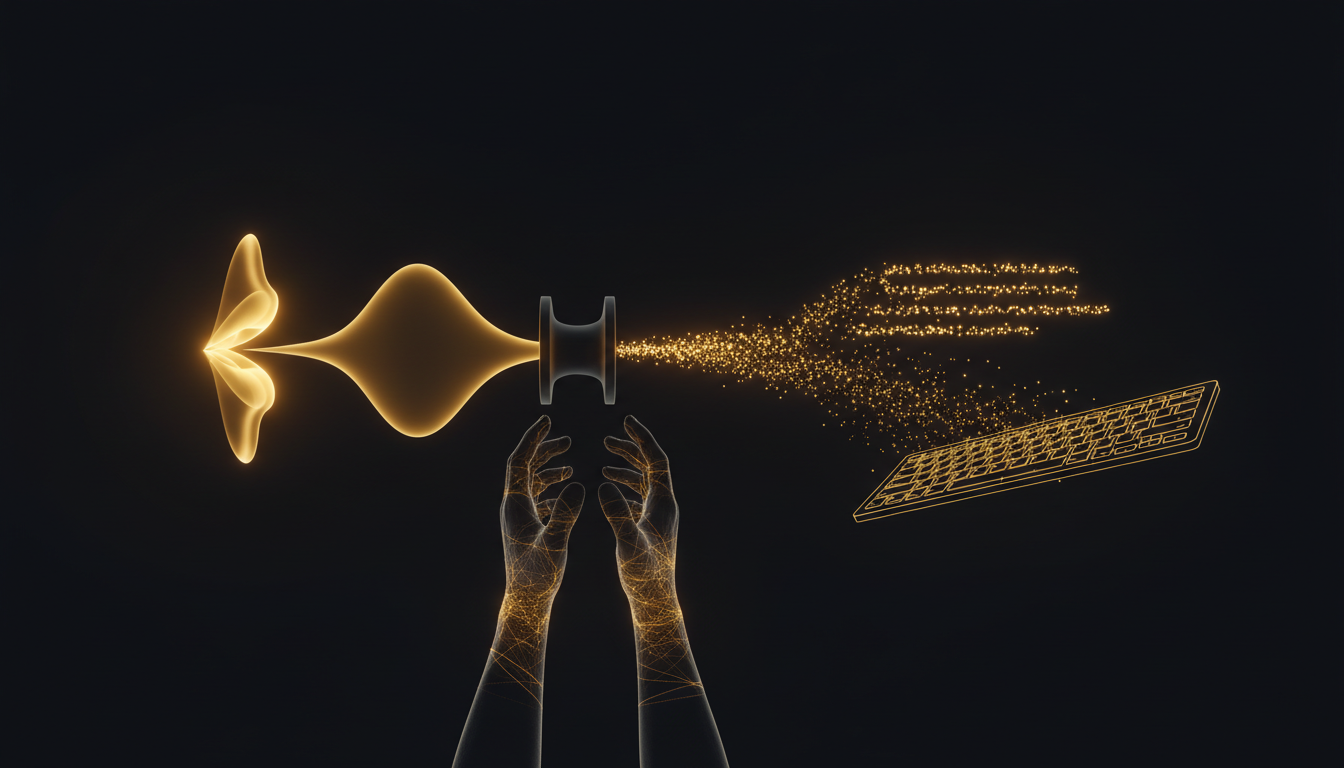
You have a thought. A good one. By the time your fingers finish the previous sentence, part of it is already gone. This is not a focus problem. It is a bandwidth problem. Your hands cannot keep up with your brain, and the gap costs you more than you think.
The Numbers Are Not Close
The average typing speed sits around 40 words per minute. Fast typists push 80 or 90. Speaking, even at a relaxed conversational pace, lands around 130 words per minute. At the high end, people comfortably speak at 150 or more.
That means even a skilled typist is capturing thought at roughly half the speed it arrives. For most people, the ratio is worse. Every sentence involves waiting, backspacing, and reformulating, not because the idea is unclear, but because the hands are slow.
What Gets Lost in the Gap
The problem is not just speed. It is what happens to ideas while they wait.
Working memory is shallow. When you are holding a complex thought and simultaneously managing finger placement, spelling, and syntax, something gives. Usually it is the nuance at the edges of the idea, the part that made it interesting in the first place.
Writers feel this acutely. A paragraph that seemed clear in the mind arrives on the page flattened. Developers notice it when writing documentation: the explanation they could give verbally in thirty seconds takes ten minutes to type out, and the typed version is somehow less clear.
Typing Rewires How You Think
Spend enough years at a keyboard and something subtler happens. You start pre-editing before you even begin. You reach for shorter words because they are faster to type. You avoid complex sentence structures because they are harder to backspace through. You stop mid-thought not because you are stuck, but because your hands are.
This is the hidden cost. Typing does not just slow output. Over time, it shapes and constrains the thinking itself.
Voice Changes the Equation
Dictation removes the physical bottleneck. When you speak, thought and output move at roughly the same speed. There is no lag between what you know and what appears on the screen.
The shift takes adjustment. Most people have been typing for decades and dictating for minutes. The first sessions feel awkward. You pause where you would normally backspace. You say "um" and expect it to disappear. It does not, at first.
But within a few days, something opens up. The sentences get longer and more natural. The ideas arrive more completely. The editing pass still happens, but there is more raw material to work with, and it is closer to what you actually meant.
Tools like VoiceInk make the mechanical side frictionless. Press a key, speak, and the text appears wherever your cursor sits, whether that is a notes app, a code editor, or an email. No setup per application, no cloud processing delay, no wondering if your words are being stored somewhere.
The Bottleneck Is Physical, the Fix Is Simple
No productivity system makes your hands faster. No keyboard shortcut gives you back the ideas that evaporated while you were typing. The constraint is physical, and the only real solution is to route around it.
Voice is not a workaround. It is closer to how thought actually works. Speaking is the most natural output mode humans have. Writing with your hands is the recent invention, and a slow one at that.
If you have never seriously tried dictation, the gap between what you can say and what you can type is probably larger than you realize. A single afternoon of talking instead of typing tends to make that clear.
Start with something low-stakes: an email draft, a quick note, a to-do list. See how fast the words come out when your hands are not in the way.
Stop typing. Start talking.
VoiceInk turns your voice into text in any app. Local, fast, private. Free to start.
Download VoiceInk Free