Why Your Hands Are Slowing Down Your Brain
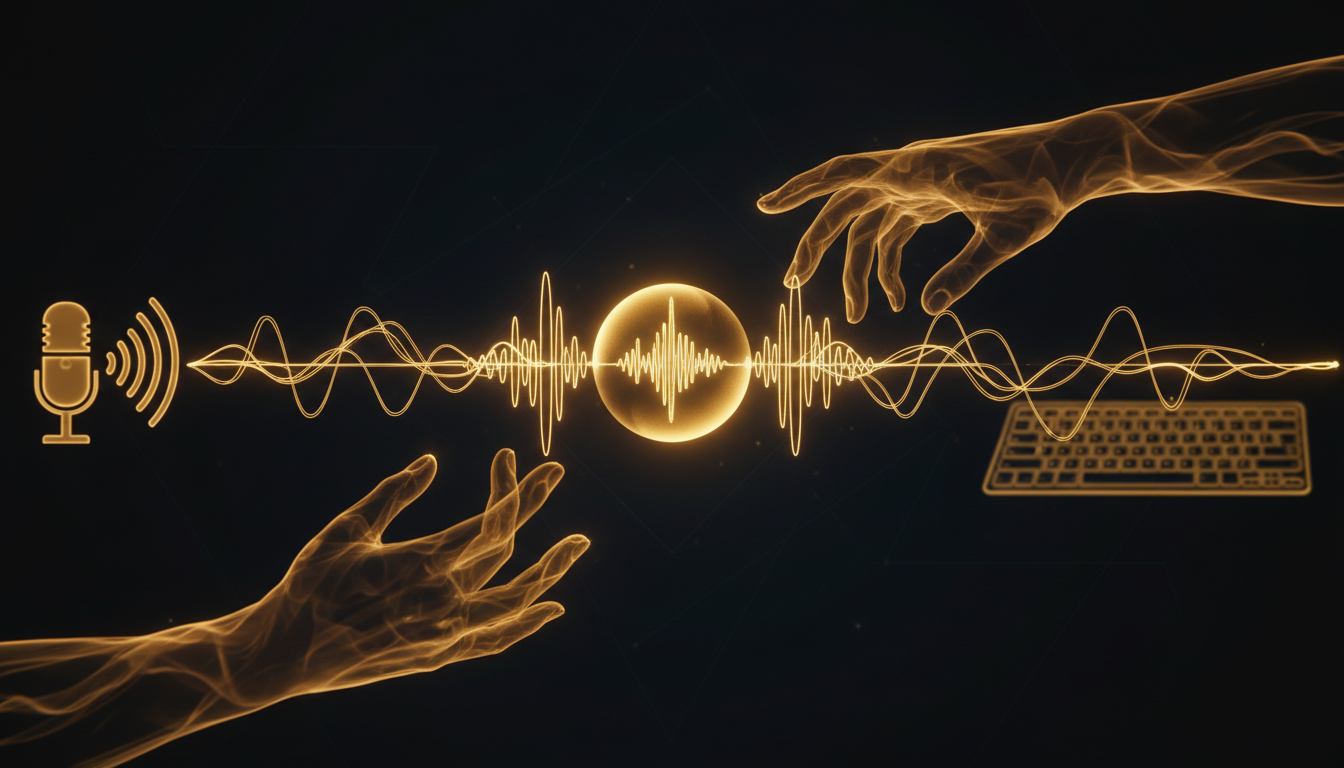
You have a thought. A clear one. You start typing and by the time you finish the sentence, half of it is gone. This is not a focus problem. It is a speed problem. Your hands cannot keep up with your mind, and the cost is higher than most people realize.
The Numbers Do Not Lie
The average typing speed for an adult is around 40 words per minute. Trained touch typists hit 70 to 80. Even professional typists rarely break 100 consistently. The average speaking speed is 130 words per minute, and most people can push to 150 or 160 when they are in the flow of an idea.
That is a 3x gap at minimum. Every time you sit down to write, you are running your brain at full speed and your output at one third of that capacity. Something has to give, and it is usually the quality or completeness of the thought.
What Gets Lost in the Gap
The problem is not just slowness. It is the cognitive load of typing itself. When you type, part of your brain is managing finger placement, spelling, and punctuation. That part is not thinking about your argument, your story, or your next insight.
Researchers call this the dual-task interference effect. When two tasks compete for the same cognitive resources, both suffer. Writing is thinking. Typing is a physical task. Doing them simultaneously means you are not fully doing either.
This is especially obvious when you are trying to capture a complicated idea, draft something emotionally difficult, or work through a problem you have not fully solved yet. The physical bottleneck turns into a mental one.
The Myth of the Fast Typist
A lot of people assume that learning to type faster will fix this. It helps, but it does not close the gap. Even if you double your typing speed to 80 words per minute, you are still operating at roughly half your speaking rate. And the cognitive overhead of typing does not disappear just because your fingers move faster.
There is also the question of sustainability. Typing fast for hours is hard on your hands, your wrists, and your posture. Speaking at a natural pace for hours is just called having a conversation.
Speaking Is Thinking Out Loud
When you talk through an idea, something different happens. You hear yourself. You self-correct in real time. You find the shape of an argument by speaking it before you have fully formed it in your head. Writers, lawyers, and executives have used dictation for decades precisely because of this. The voice externalizes the thought in a way that fingers on a keyboard do not.
This is not mystical. It is mechanical. When your output channel matches your thinking speed, you stop losing ideas in transit.
Making the Switch
The barrier used to be accuracy. Early voice recognition was painful enough that most people gave up. That has changed significantly. Tools like VoiceInk run locally on your Mac, process speech in real time, and drop text directly into whatever app you are using. There is no cloud upload, no lag, no subscription sending your words to a server somewhere.
The workflow is simple: press a key, speak, release the key. Your words appear. You can do this in your email client, your notes app, your code editor, or your writing tool. The app you love does not change. Only the input method does.
You Are Not a Slow Writer
If writing feels like a slog, the bottleneck is almost certainly your hands, not your ideas. The thoughts are there. The words are there. The question is whether you have a fast enough channel to get them out.
Try speaking your next email instead of typing it. Just once. Pay attention to how it feels when the words come out at the speed you actually think. That feeling is what dictation does when it works right.
Stop typing. Start talking.
VoiceInk turns your voice into text in any app. Local, fast, private. Free to start.
Download VoiceInk Free